
What it the definition of an accident you may ask? The Cambridge Dictionary say’s:
accident (noun)
something bad that happens that is not expected or intended and that often damages something or injures someone:
(Ed Note: But in my experience accidents are not normally a singular event but often occur after a number of events come together.)
Introduction:
We must remember that the railways were a brand new industry with many heavy moving parts, it was almost inevitable that there were would be many accidents in this fledgling industry. (Exploding engines, broken rails, lack of signals, gas-lighting fires, inadequate brakes, cows on the line – these were some of the dangers encountered.) In 1840 through an Act of Parliament the first railway inspectors were appointed. It was their job to inspect the construction and equipment on the new railways and they were also responsible for investigating accidents and recommending ways of avoiding them in the future.
(Ed Note: In 1874 there were 788 railway worker fatalities on railways throughout the country, in 1983 this had reduced to 28 deaths, by 1992-93 this was further reduced to 11 deaths and by 2015-16 it had gone down to 4 railway workers losing their lives. )
Accidents on the VoNR line were a regular occurrence with the majority of accidents being the result of human errors of judgement or carelessness. This can probably be attributed to the long hours the railway men worked and their attitude towards their own safety which in the early day’s of the railways was much more casual.
Over the lifetime of the Vale of Neath Railway there have been many accidents and fatalities that have occurred at various points along the line. This article will look at the these events and explain the events that led up to these accidents.
Timeline of Accidents on the Vale of Neath Railway line (VoNR):
1858: One of the earliest fatal accidents occurred seven years after the Vale of Neath Railway Line was opened. A famous bard David Griffiths (Bardic name Dewi Nedd) was killed on the the 7th of February 1858 and his story is recorded in D. Rhys Philips famous book A romantic Valley in Wales ~ History of the Vale of Neath (pages 559-562) [2]
But before describing the incident let’s look a little into the history of the man himself. David was employed by the Rheola Estate as a Woodward who lived a Crugau.
(Ed note: Woodward is an English occupational surname meaning a “forester,” “wood-warden,” or “keeper of the forest”. Derived from Old English wudu (wood) and weard (guardian), it historically identified officials responsible for protecting timber and game in medieval woodlands.)
He wrote many short 3 line tribal-stanzas which unfortunately have been lost to time, and also composed several humorous skits. There are songs about the Rheola Bull which fell into a gutter and of the fate of a fat pig which fell into a `winch` at the Ton, Resolven. There is a song about a local incident as well, the woodmen of Rheola were working near to Cwmgwarch when they were asked to help put out a brushwood fire at Argoed farm which was a customary occurrence in late autumn. The woodworkers managed to convince the farmer to pay them a sovereign for their services and we know how tight farmers are with their money. His most famous song refers to a fox hunt on the Rheola estate by a Mr Morgan Jenkins and his dog `Driver`. The song was sung for many years after the event.
Davids other skills were wood-carving and an example of his work can be seen in the photograph below of the front of the upper lodge at Rheola.
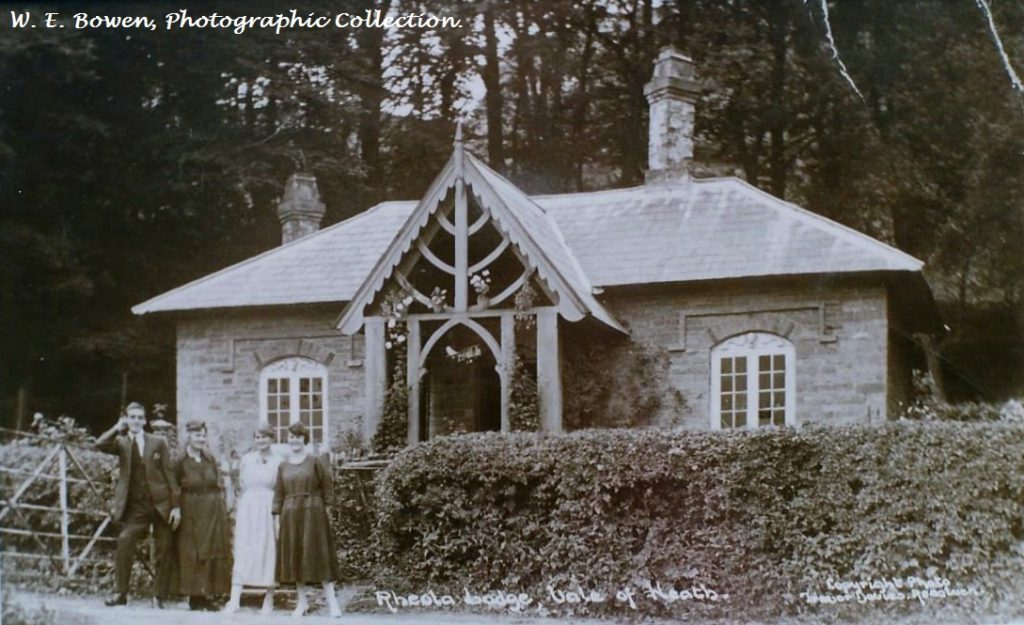
Now to the story of his demise, he unfortunately was killed by a train when attempting to cross the railway tracks near Glynneath station on February 13th, 1858. He was laid to rest in St’ David’s Church, Resolven with the headstone being provided by the Vaughan family of Rheola.
The articles shown below are from `Disasters and Day Trips on the Vale of Neath` by G. F. Gabb and can be found in the Neath Antiquarian Society Transaction book of 1978, page 58 – 60. [3]
1863: On the 11th September, 1863, a calamity took place which illustrates the routine risks taken by the people working on the VoNR. The coal train left the station at 7.50 pm with the first guard Thomas Wright and as the train had no brake van a second guard David Jenkins. Wright explains the when coming down the Hirwaun incline they clamber from one truck to another to apply the brakes.
When they reached Neath they noticed that Jenkins was missing. They then went to check the pay office and his lodgings to see if they could find him but with no luck. The stoker and the engineer then took the locomotive back over the route to see if they could find him. They eventually found him mortally injured near the Penrhiw sidings, which are 4 miles from Hirwaun. A classic example of an error of judgement on a busy railway.
1863: On the 11th June, 1863, Stoker Ben Lewis was killed when crossing the line to fetch coal for his locomotive at Briton Ferry station.
1863: in November, 1863, a train ran into another train standing at Neath station. The Cambrian newspaper reported that: “The station masters an engine approaching on the same line, and with great presence of mind… signalled the engineer of the train to move on…. Thus making the collision less severe.” Nevertheless the passengers were still shocked and bruised, but it could have been a lot worst.
1864: In January, 1864, a young newsboy lost his foot when crossing the line at Wind Street when an engine and four coaches passed over it.
1864: On the 10th July, 1864, a passenger train left Swansea station at 8pm but was derailed at St. Thomas’s just outside Swansea with three of the six coaches leaving the track, luckily no casualties were reported.
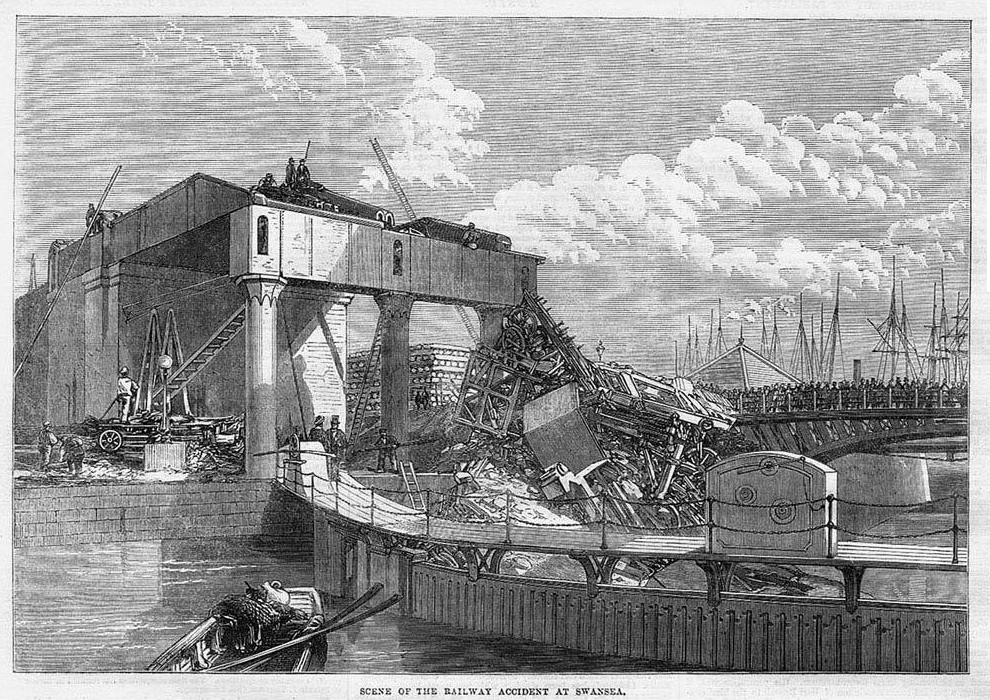
1865: One of the worst accidents on the VoNR line took place near Swansea when on the 28th November, 1865, when a bridge over the North Docks was left open and the Neath to Swansea coal train plunged into the dock. This is a classic example of an accident being caused not by a singular event, but by a series of events which led to the disaster. The drawbridge had to be kept open to shipping for 2 ½ hours before high water and 1 ½ hours after high water for each tide, this meant that coal traffic usually ceased about 8:30 pm and resumed around 4 am. On the day the signalman, John Howells, came on duty at 4 am with the drawbridge open. Unfortunately he could not close the drawbridge as there was not enough hydraulic pressure: and hour later then there would have been enough power. To compound the problem even though the drawbridge was open, an incorrect `line clear` signal was showing. A red warning light was automatically shown if the drawbridge was open.
The coal train driven by William Cole was having difficulty getting traction on the rails as they were so slippery, so the driver was having to work the train regulator in and out to gain traction. The train was travelling bunker first so the driver had his back to the direction of travel. At 6:30 am the coal train with 32 wagons with the Driver William Cole and stoker Clement Longstaff plunged into the North Dock water and drowned. The guard George Garish was more fortunate as he had the presence of mind to jump from the train and survived.
The signalman John Howells admitted responsibility for the accident and was found guilt of manslaughter and sentence to 6 months imprisonment. The jury, to be fair to them, recommended mercy due to his long working hours. His normal working hours were 14 hours a day but with overtime this could extend to 17 hours a day. His average working hours for the previous year were 15 ½ hours.
1866: On the 7th May, 1886, in the early hours of the morning either a tyre came off a waggon wheel or an axle broke, which led to 20 trucks being thrown off the line near Glynneath. The tracks were `smashed to pieces` and both lines were blocked , when the up line was cleared it was reserved for passenger trains and the mineral traffic was suspended for the day. (Giving priority to passengers services was a common practice in those day’s)
1866: On the 10th September, 1866, a Train travelling between Merthyr and Neath was stopped by the driver when it set off a detonator on the track near Aberdulias. (Ed note: Detonators were used to inform the train driver of any problems on the line.) The guard on the train ordered him to proceed leading to a collision with a coal train and unfortunately there were some bad injuries.
1867: A near disaster occurred in January, 1867, when a loaded coal train was shunted into a sidings of the Eastern Depot, Port Tenant to clear the way for a passenger train on the same line. Unfortunately they did not fully move the coal train into the sidings and left six wagons still protruding onto the main line. Fortunately the passenger train was slowing down on its approach to the station and even though it did not see the lights of the coal train as it was at right angles to the oncoming passenger train they collided but with no serious injuries to anyone.
1867: A coal train was left without adequate braking and left Hirwaun station and rolled down under its own steam into Aberdare station were it smashed into a good train killing half a dozen pigs and spilling gallons of beer.
1867: In the November, 1867, it was reported in the august pages of The Times that one of Brunel’s famous timber viaducts located between Hirwaun and Glynneath had given way under the weight of a coal train. The Cambrian newspaper pointed out that regular checks were carried out on another wooden viaduct at Landore.
1868: The Brecon County Times reported on the 23rd May, 1868, on the inquest of a fatal accident at Glynneath Station. The accident happened on a Sunday morning when the driver of a goods train Mr. Richard Jones left Neath station at 1.20 am with one engine and 44 trucks, 40 empty trucks and 4 loaded. As they approached within 80 yards of the Glynneath station they ran over something on the line and the head guard a Mr. David Thomas went to investigate. The time being ten minutes to two in the morning.
David Thomas then told the inquest that he felt the truck he was in jump, he met his mate who told him they had run over a man, the mate said it was William Owen a ganger. With that information Thomas ran for a Doctor a Mr. Jones, but the doctor refused to come.
The next witness was Mr. Rees Evans a goods guard living in Cwmgwrach who was also on the train. He said after the train had stopped he heard a groan and got off the train to see where it had come from. Evans saw the deceased right in the middle of the road and said the last truck had gone over him. At this time William Owens was still alive and he said, “Rees, I have come into it at last; please left me up on my feet”. The deceased two legs were off and his right hand was damaged, he then ran away and met David Thomas. who then went to look for a doctor; he also said he didn’t think the deceased was under the influence of beer.
The next to give evidence was Mr.Alfred Padfield who lived in Cwmgwrach and was a packer on the VoNR, he said he had met the deceased at the White Hart pub in Glynneath about half past severn on Saturday evening. He was in the company of Mr. Tucker and his wife, Reuben Castle, the deceased, Philip Tanner, Mr Morgan and himself. They left the White Hart around 12.30 am to walk home. The above parted company when the arrived at Glynneath station, Mr. Tucker and his wife and the others went over the stile leading to Cwmgwrach. He went on and when he came to th crossing he did not wait for the deceased, he also said the deceased was not sober. Padfield also said he did not see the train and did not hear the train at all; he mentioned he had a little beer, and he couldn’t remember seeing David Williams at the station when they passed; and mentioned that there was no larking about on the way home and the deceased walked home very well, he did not stagger much.
Mr. Ruben Castle the local Glynneath policeman said he saw the deceased at the White Hart club-room and the he overtook him ot the Lamb and flag when walking home. He said they were singing and larking about, the deceased was not drunk but he had had some beer. The deceased died on Sunday morning.
Next to give evidence was Mr. Mark Tucker the station-master who said the deceased was the worst for liquor but was capable of taking care of himself.
The coroner returned a verdict of “accidental death.”
1920: On the 4th September, 1920, the 70 year old Justice of the Peace Mr. William Davies JP, who lived at Plas -y-Felin in Pontwalby, was killed by a train near Pontwalby Halt.
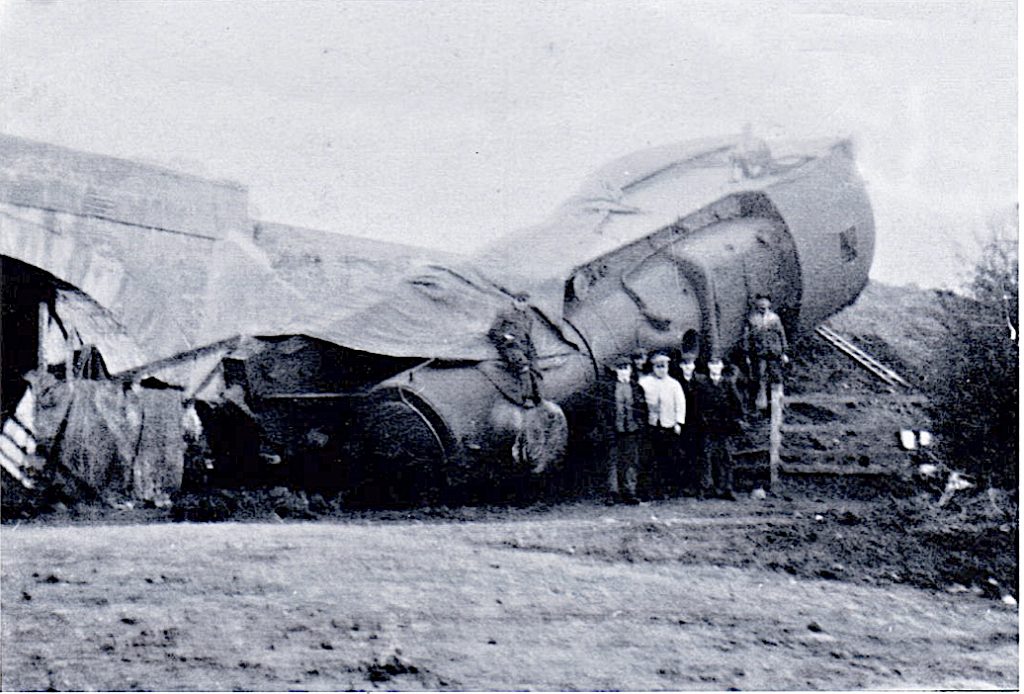
Unknown Date: An engine was derailed by the Venallt road railway bridge, a few hundred yards below the station. The engine probably left the station after the brakes were not applied correctly and came to rest on the embankment as you can see in the photograph below.
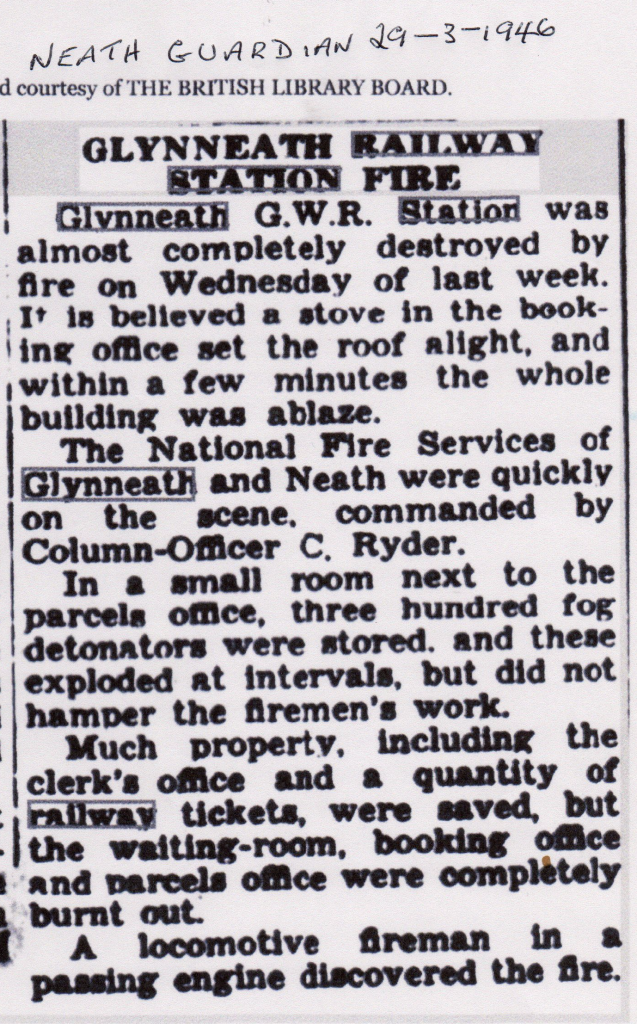
1946: On the Wednesday, 20th March, 1946, the Glynneath railway station was set ablaze. The Neath Guardian reported on the 29th March that the waiting room, the booking office and the parcel office were completely destroyed. The only place saved from the fire was the clerk’s office, along with some railway tickets. The Guardian reported that the fire was startled by the stove in the booking office setting fire to the roof. See newspaper clipping on the left.
Contrary to the Guardians version of events, Peter Ricketts, an eye witness to the event on his way to school in the morning, said, “I saw smoke coming from the rear of the station above the outside gents toilet.” On his retuen from school he was told that the fire had started by an engine at the rear of the station in the Empire Colliery screens sidings emitting red hot cinders onto the sation roof, which in turn set fire to the building’s eaves and spread rapidly along the station roof. (Read Peter Rickets Memories click here) [4]
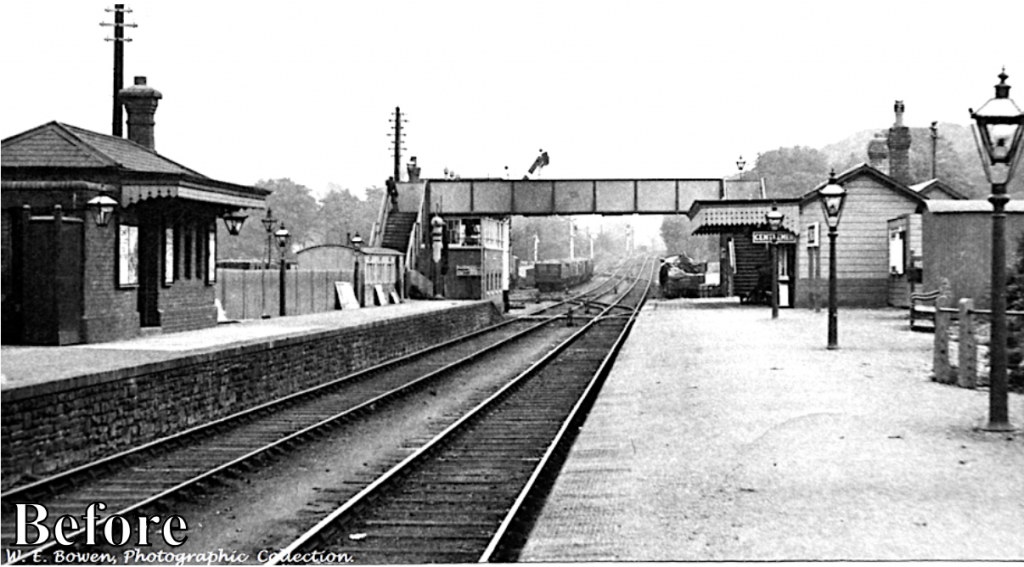
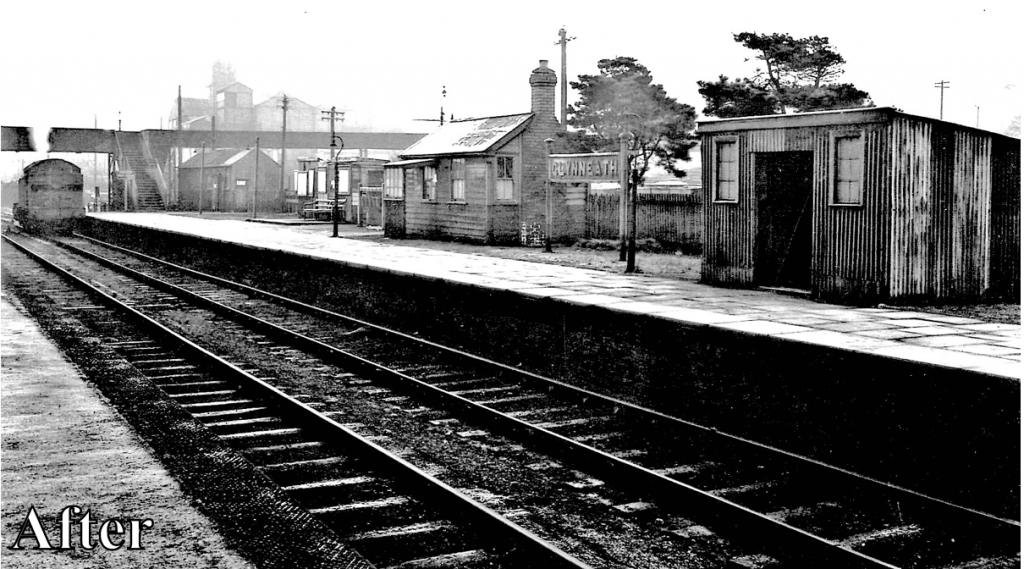
Before and After the fire photographs, the After photograph shows the temporary buildings built after the fire.
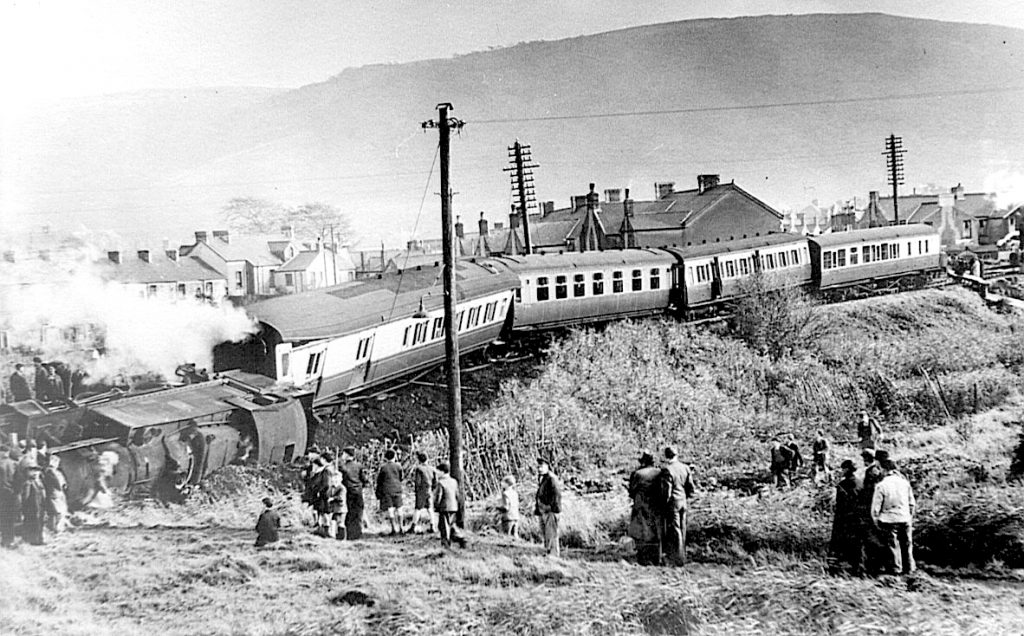
1950: On the 9th October, 1950, at Cwrt Sart the 2pm down train from Cardiff to Swansea hit an articulated motor lorry on the Cwrt Sart Farm Occupation level crossing. The lorry was driving over the level crossing but the driver misjudged the width of the far side gate and came to a stop with the rear end of the lorry across the rail track. The engine travelling at 40 mph, hit the lorry and was completely derailed and fell on its side as you can see in the photograph. Of the 28 people on board 9 were injured, but none seriously, the emergency services were quickly on the scene and were assisted by trained first aiders from the nearby engine shed. [5]
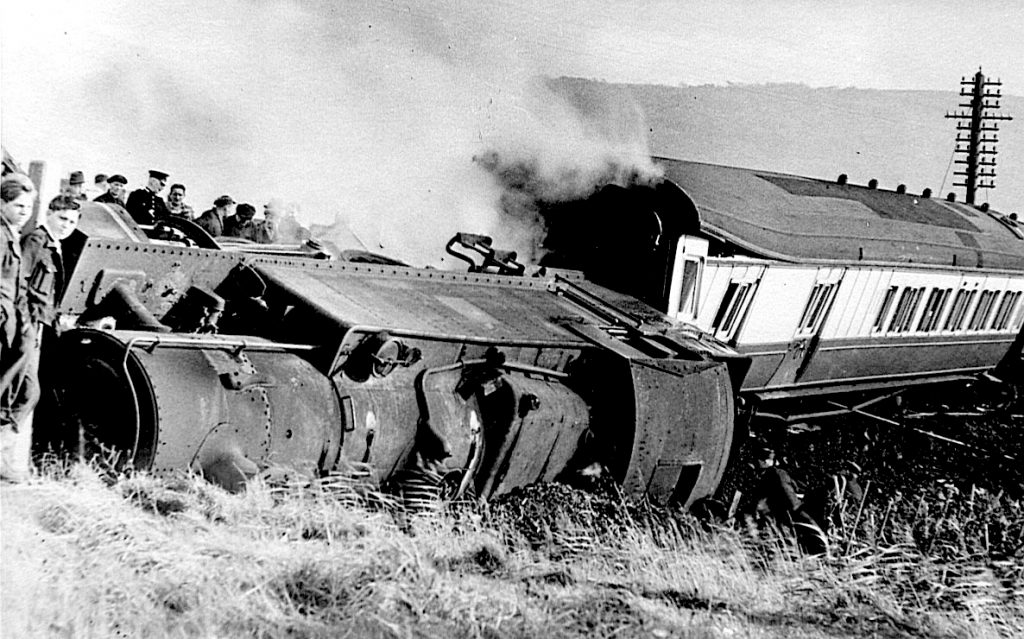
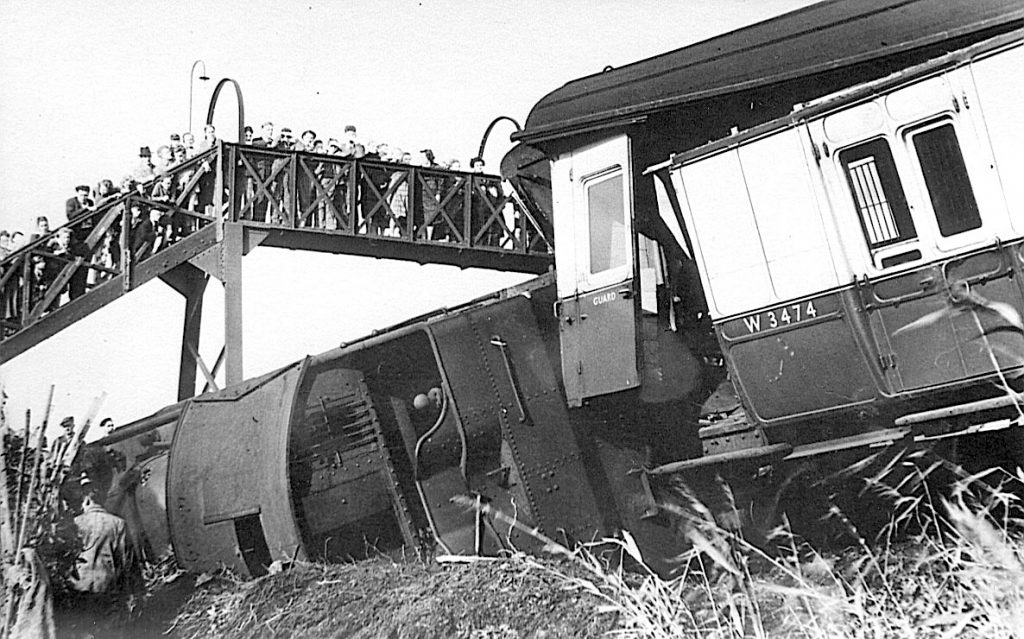
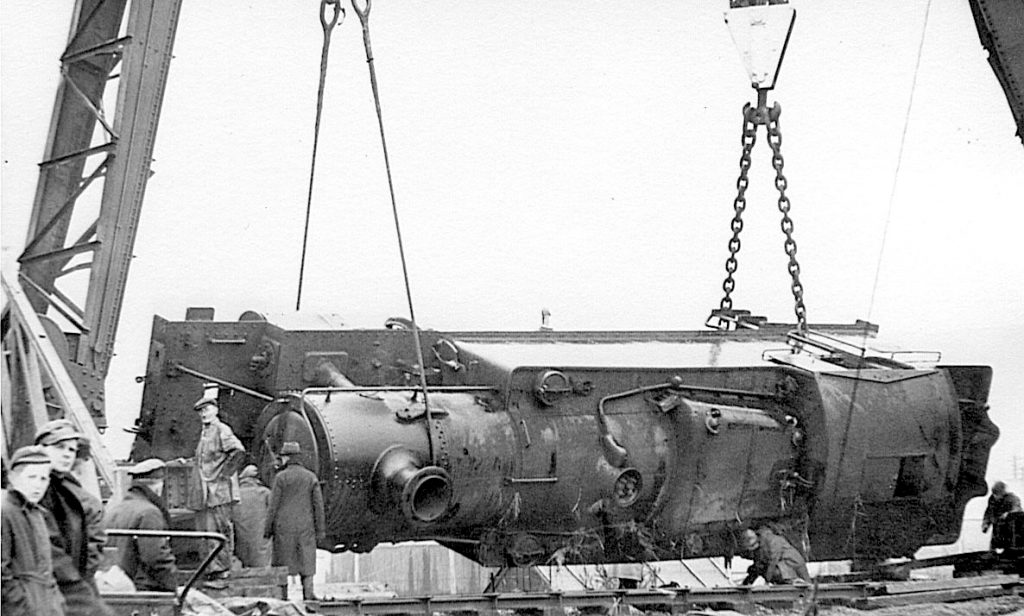
Photographs from my father’s collection, but can be attributed to Gerald Williams collection. [1]
Weather related incidents:
1852: On the 17th August, 1852, the Morning Post reported on a great storm that took place on Craig y Llyn above the village on the Monday afternoon. At about 3 pm dark thunder clouds were seen gathering on Graig y Llyn with flashes of lightening and heavy peals of thunder. Then the heavens opened and a great deluge of rain fell leading to a rush of water carrying large masses of stones and earth making its way towards the village.
The full force of the water hit just above the Railway Station and carried off a portion of the embankment of the railway line, leaving the rails unsupported. This happened just as a train was due at 2.47 pm at the station, luckily it arrived a few minutes before the storm took place, but due to the mass of stones carried over the line it was impossible for the train to proceed to its destination of Neath.
It was reported that about 40 tons of earth had been carried away by the flood water. The rain fell for only an hour and was one of the heaviest showers ever recollected in the village. The torrent of water took down houses and large trees were uprooted and quickly got trapped under the railway bridge at the Venallt, blocking the water from flowing under the bridge and making a new course along the railway embankment. It eventually formed a new course across the railway line such was the depth of water and deposited a vast quantity of debris on the field on the other side of the embankment.
The damage caused to the line was quickly repaired and the Swansea train due at 3.50 arrived in Swansea at 8.30 pm, it must have been a Herculean effort to repair the line in such a short space of time.
1857: In June, 1857, the Dare Viaduct on the branch from Gelli Tara to Aberdare was affected by extreme heat at the end of June due to thermal expansion of the rails. This particular viaduct had 11 spans and was built on a sharp curve and the heat of the day had caused the rails to expand, which in turn forced the viaduct a few inches sideways disturbing the line and rendering the line impassable.
The rails and viaduct were soon restored to their correct position by the introduction of expanding joints on the rails. This idea was then introduced into other viaducts and therefore guarding against this problem reoccurring on other viaducts under similar circumstances.
1865: On the 22nd December, 1865, the route to Swansea across the Crymlyn Burrows was severely flooded by a tremendous storm. The Cambrian newspaper reported, “The water was so high that it stopped…the passage of trains…the line being several feet deep in water.”
1865: The Bristol Post and the London Evening Standard carried the same story on 28th of January, 1865, on Thursday afternoon a terrible collision on the Vale of Neath line occurred at Aberdare station, which resulted in the destruction of a vast amount of property, but fortunately no life was lost.
A few days before the accident it had been snowing heavily which meant the rails were extremely slippery. At two o’clock in the afternoon a train of 41 empty coal trucks, on the broad gauge track, left Hirwaun station bound for Aberdare. The weight of the coal trucks and engine was estimated as being about 300 tons.
On approaching Aberdare and descending down the incline, the brakes on the engine were applied as a precaution. They brakes gradually increased their grip on the wheels, but the wheels had no bite on the rails, leaving the train to gather speed as it travelled down the incline.
Every effort was made to slow the train down but with no luck. At the same time an engine was shunting into the Aberdare Station yard. The signalman seeing what has happened turned this train into an empty siding so as to avoid the station, but his action was to late to get the shunting locomotive out of the way.
The result was the two trains collided and a truck infront of the shunting engine was completely smashed to pieces, but it saved the engine from being too damaged, although it was hit with such a huge force it was turned completely around and ended up at right angles with the line.
The second engine was lifted completely off the rails and thrown to one side but kept upright somehow. The first 12 wagons were smashed up with some of them dashed to pieces with others being piled on top of each other. The driver of the engine bravely stuck to his post and was miraculously was not hurt, as the tender was almost doubled up and a large wagon leapt over it and fell on its side were he stood.
Luckily the accident happened where it did for if it did not turn off the main line it would have carried on to the station shed where there were loaded wagons on one line and a narrow gauge train standing on the other line, which would have led to even more destruction.
1930’s: My mother Mair Bowen (nee Jones) told me the story of how Cedar Street got it’s name. She said in the 1930’s a pile of Cedar wood planks fell off a train and they were subsequently stored by the side of the track alongside where Cedar street would be built. She said they used to play on them as children and that they gave off a strong smell of Cedar. She though this is why Cedar Street got its name.
I have no way of collaborating the story above but would just say my mother had very strong memories of growing up in the village.
References and Resources:
[1] Photographs from my father’s collection, but can be attributed to Gerald Williams collection and can be found in the book
– Neath Enginemen: Reminiscing Steam in South Wales book by Bryan King (Oakwood Press)
[2] A romantic Valley in Wales ~ History of the Vale of Neath (pages 559-562) by D. Rhys Philips.
[3] Neath Antiquarian Society Transaction book of 1978, `Disasters and Day Trips on the Vale of Neath` (page 58 – 60.) by G. F. Gabb.
[4] Peter Ricketts memories article in the Gwrachtimeline website. https://gwrachtimeline.co.uk/the-memories-of-mr-peter-ricketts
[5] https://www.railwaysarchive.co.uk/docsummary.php?docID=921
Various old Newspaper cuttings.
Photographs from the Glyn Davies and Billy Bowen collections.