
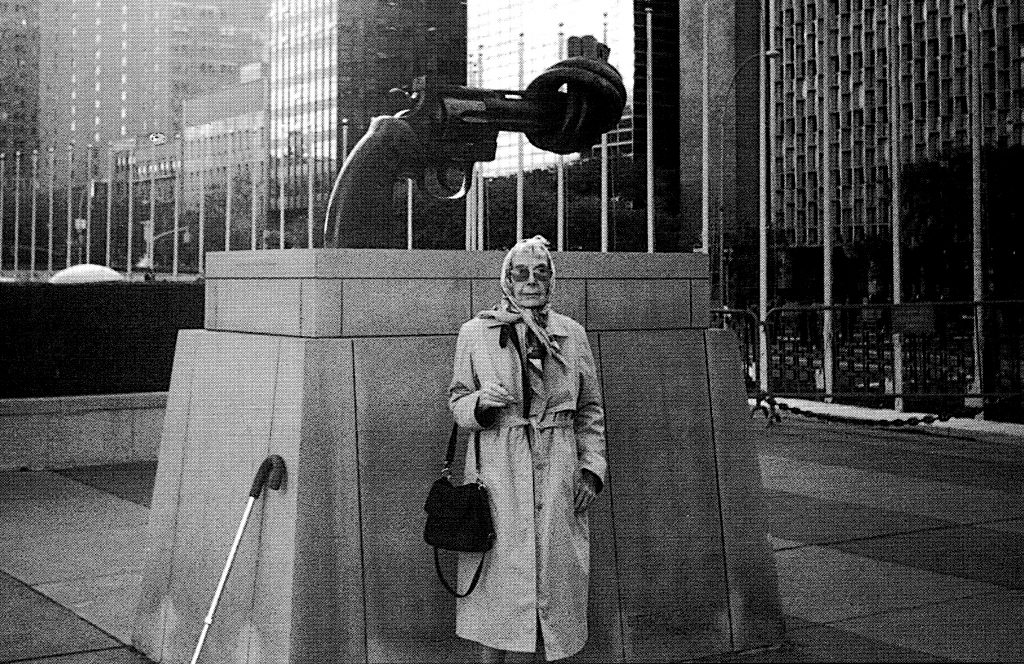
Eileen Egan outside the United Nations building, New York City. The photograph was taken by Ian J Currie in October, 1999 and shows Eileen Egan beneath a monument of a pistol with a knotted barrel, a symbol of nonviolence. Ian say’s of the photograph, “I remember feeling when taking it, how significant it was to have such a symbol of peace alongside a woman of peace”.
Photograph copyright Ian J Currie.
Eileen Egan at Cwmgwrach
Which, in a copy of her final book “Peace Be With You” presented to Ian Currie in 1999, she refers to as:
“a corner of the world that is dear to me“
I have written extensively about Eileen Egan, ever since I first learned of her incredible life; especially in relation to her unceasing humanitarianism. I have also given numerous ‘Talks’ about this exceptional woman. But, of course, there is no way, given our completely unrelated lives, that I would ever have even heard of her, had she not spent her formative years (from seven to fifteen) in a village, the history of which, I decided to research and write about.
The significance of this serendipitous coincidence was recently brought to my attention by Roy Bowen of The Gwrach Timelife History Team. Roy expressed his personal admiration for Eileen Egan who, in the recently published book “Reflections of a Bygone Age – Blaengwrach & Cwmgwrach” compiled by the History Team and written by Roy, is described as:
“probably the most famous person who has lived in the village.”
In an Email to me Roy writes: “An idea just came to mind this morning; maybe you could extract the relevant parts of your book “The Egan Chronicles” that only refer to Eileen and the Egan’s family time living in the village.”
So, in response to this, I have engaged some time in seeking out those specifically relevant parts. The following therefore, is an attempt to at least relate something of Eileen Egan’s time in Cwmgwrach in the form of a synopsis; there being insufficient reference to compile a comprehensive narrative.
But first, for the benefit of those unfamiliar with Eileen Egan and her life, it will necessary to relate something of her most significant roles and achievements throughout a long and immensely committed life. For me, it was not her truly devout Christian Catholic faith that I most admired but her devotion to the care and responsibility of those countless displaced persons; affected by war. She being totally opposed to any form of violence.
During World War II Eileen Egan (being fluent in Spanish) was engaged by N C News Service, USA’, though not on full time staff, to report on the plight of refugees who had escaped from Fortress Europe and fled to Portugal. Her reports were of such a high standard that they had caught the attention of Bishops charged with the foundation of The Catholic Relief Services (an organisation being set up, financed by the US government, in anticipation of untold numbers of displaced refugees, as a result of the war). She was the first female member and was immediately sent to the Colonia Santa Rosa refugee camp in Guanajuato, Mexico.
The camp contained mainly Polish refugees who had been imprisoned in Siberia, during the Nazi/Soviet Pact. This was Eileen’s real introduction to the world of the tragedy of displaced people; including many children, some of whom had witnessed the death of parents and other family members en route from Siberia. By the time Eileen left the camp she had initiated many changes to improve the conditions for the refugees and was looked upon by the adults with extreme deference and by the children as a mother figure.
At the close of the war, concern was raised for people left in the ruined cities of Germany; mostly old men, women and children, who had played no part in the war, dying of starvation and lack of shelter. Appeals to the allied leaders, by Aid Agencies, including the Catholic Relief Services, fell on deaf ears. But their pressure, including a personal role by Eileen, was relentless, finally forcing the collective leaders to allow a group of Aid Agencies, combined under the title Council of Relief Agencies Licenced to Operate in Germany (CRALOG) to move into the country. Eileen Egan was, later, to become the “Chairman” of the Catholic Relief Services’ branch of this organisation. As a result of her role in helping these desperate and ostracised people over a long period of time, Eileen Egan was, later (in 1962) awarded The Medal of Gratitude by the French Government and The Order of Merit by the German Government; the highest civilian award of each respective country.
It was in 1955 while working for the Catholic Relief Services in Delhi, India, that Eileen Egan’s attention was drawn to a Catholic nun in Calcutta, who, she was told, was helping to take dying refugees off the streets, not to treat them (as she did not have the where-with-all) but to give them a place of dignity to die. This led to Eileen Egan meeting Mother Teresa and becoming a close friend and aiding her, through the Catholic Relief Services, over several years. It was Eileen Egan who accompanied Mother Teresa to Oslo, Norway, on 10th December 1979, when she received the Nobel Peace Prize.
In 1986, Eileen Egan published the authorised version of Mother Teresa’s biography “Such a Vision of The Street” A thoroughly researched and authenticated production, gratified by Mother Teresa.
Pax Christi is today an International Peace Organisation originally initiated by a French woman, (Marthar Dortel-Claudot) a teacher, who had become greatly disturbed by the killing in World War II. Other, like minded people, joined her and on March 10th 1945 Pax Christi was founded. Other independent branches of Pax were established and gradually united. One such group was American Pax and Eileen Egan was a leading figure in founding this movement. It was she who was deputed to address the Council of Pax Christi, International, as was necessary to gain official recognition. Eileen describes her approach to this address in her book “Peace Be With You”
“Carrying with me the reports of our programmes and examples of our Peace Quarterly magazine, I made my way in April 1972 to an executive council in Luxemburg (entirely at her own expense) All the printed material of American Pax were examined, followed by an extensive hearing, presided over by Cardinal Bernard Alfrink, President of Pax Christi International. The result was that America Pax was accepted as a matrix of the US national section of Pax Christi International.”
Of all Eileen Egan’s incredible achievements, however, she told me while I was with her in New York, that the thing she considered most rewarding, was the very prominent part (after seventeen years repeatedly appealing, with others, to the United Nations Human Rights Commission) she had played, in the right to conscientious objection.
In 1987 the following declaration was placed on the UN statute book:
‘Conscientious Objection to military service should be considered a legitimate exercise of right to freedom of thought, conscience and religion, recognised in the Universal Declaration of Human Rights and the International Covenant of Civil and Political Rights.’
Eileen Egan could justly claim to have played a leading role in bringing this about.
Eileen Egan’s name appeared on the Pacem in Terris and Freedom Award for 1989. This award has been presented annually since 1964, to a single individual, to honour their achievements in peace and justice, not only in their country but in the world. To give you some idea of the significance of this award, the following are some other recipients:
John F Kennedy (posthumously in 1964); The Reverend Martin Luther King Jr. (1965); Saint (Mother) Teresa of Calcutta (1976); Archbishop Desmond Tutu (1987).
The foregoing is a very brief summary of Eileen Egan’s humanitarian commitments and only touches upon a life of selfless dedication to easing the suffering endured by those, cast out as a result of war. I was very privileged to have met this incredible woman and learn, first hand, (while we lunched in the United Nations Headquarters, New York – she being a retired UN Delegate) of her life’s work and sacrifice in her role as peace advocate and dedicated aid worker.
———————-
Jeremiah Egan left Ireland in 1909 for Pontypridd and after finding a job in a coal mine and a suitable place to live, he sent for his fiance, Mary Agnes Ahern O’Sullivan Bere, to join him. On October 15th 1910 the couple were married at St. Dyfrig’s Roman Catholic church in Pontypridd. On December 27th 1911 their first child, Eileen Mary, was born. They were to have two other children, Kathleen and James, before moving to Cwmgwrach in 1917, where an opening for an experienced Timberman at Aberpergwm Colliery offered Jermiah better prospects.
The little cottage, 4 Miners’ Row, in a terrace set on a hill between two other terraces, Mount Pleasant and Venallt Terrace (today known collectively as Heol y Graig) was a typical miners’ dwelling. And it was here the Egan family were to remain until March 1926, during which time two more children (Bernard and Mabel) were born; before the family sailed to America and a new life.
Eileen refers to her attendance at Blaengwrach School, which was less than ten years old when she started there, having opened in January 1908. She says that she was very happy there and mentions some of her teachers; Miss Lucy Elizabeth Waterfall, a Quaker, originally from New Zealand and Mr John Emlyn Jones (headmaster during my time at Blaengwrach) who gave Eileen extra tuition in maths, which helped her pass the County School exam. And then there was a Miss Reed, who befriended the Egan family. The headmaster was Mr Nichols.
The children soon settled happily at Miners’ Row, and befriended their near neighbours’ children; Jimmy and Ronnie Trindall. As in my own childhood, the Egan children enjoyed the liberty to roam the local hillsides. Eileen recalls she and her sister Kathleen, along with the Trindall children, “trekked all the way to the Olchfa” (the sheep dip above Argoed farm). But Eileen felt sorry for the sheep and says that the farmers did not welcome them, not even offering them a drink. Eileen obviously had a strong caring for animals and was horrified at the sight of a pig being slaughtered by the Williams family next door. It wasn’t uncommon to keep pigs in the garden at that time.
And something perhaps even more sensitive:
“We visited the body of one of our classmates, a handsome boy in a white siege suit, who had died suddenly. And on another occasion, in the same block of houses, lower down, (probably Mount Pleasant) we saw a girl of about 10 or 11 in a white dress with a garland of white flowers draped around her dark hair.”
During July and August the children would climb beyond the Olchfa to pick whimberries. Apparently, it was Mrs Williams, next door, who made the best whimberry pie so, with their mother’s consent, the children would take the whimberries there and everyone would get a share of the pie.
While the family never went away on holidays, during the school holidays Eileen recalls:
“The summer holidays would not have been complete without a charabanc (roofless bus) trip to the Lady Falls at Pontneddfechan. Some dozens of families would hire two charabancs for the day and we would all pile in with food and cooking pots for a picnic.”
While at the site of the Dinas Rock, the children were entertained by their father when he related the story of King Arthur who, legend has it, still waits beneath the rock, with his circle of warrior knights seated at the round table, ever ready for their call to arms.
Mrs Egan was a devout Catholic Christian and a member of the Third Order of St. Dominic. But there was no Catholic church in Cwmgwrach. As a consequence the family travelled to Neath to worship. Later, however, the priest began to conduct Mass at Glynneath and became a friend of the Egans. On one occasion when visiting the Egans, dressed in his soutane and habit, a crowd of children trailed behind him to Miners’ Row, declaring that they had followed the Pope to the Egans’ house.
But Mrs Egan was not opposed to the children attending the local chapels or parish church as Eileen mentions:
“I joined the Band of Hope at Siloh. I also sang at concerts in Calfaria and went to bible classes at the Anglican Church of St Cadog (Aberpergwm church) under Vicar Joseph Llewellyn Thomas”
Many years later Kathleen Egan, when visiting her friend Nancy Davies of Cwmgwrach, while wearing her Benedictine Habit, was proud to be invited by the Minister of Calfaria (Nancy’s brother) to address the congregation in service.
As a consequence of this strong religious devotion, the walls of 4 Miners’ Row were adorned with pictures of distinctly religious content. Kathleen recalls:
“One was of Jesus, with long brown hair with rays of light emanating from his heart. Another of the Virgin Mary, with long dark hair and sad weeping eyes. She too had rays of light emanating from her heart which, however, was pierced with a small dagger. Between these pictures hung a large crucifix.”
The traditional Sunday dinner was not wanting at the Egan residence, as explained by Eileen:
“There was always a feast on Sunday, most often a leg of lamb with roast potatoes and string beans. For dessert we had tinned peaches and Devonshire clotted cream. On special occasions we had trifle soaked in sherry wine, so that we would not forget the value of food and our gratitude for having it, the trifle was served in an oblong cut-glass dish with ‘Waste Not’ cut into one side and ‘Want Not’ on the other.”
There is no doubt that Eileen held many nostalgic treasured memories of her childhood years at Cwmgwrach.
“As I look back, I realise how our family became part of the rhythm and spirit of Cwmgwrach village life, the carol singing when we children went from door to door to welcome the coming of Jesus with song, the annual event of the Male Voice Choir (The Dunraven Singers) where the men stationed themselves before Miners’ Row for their concert, and the summer picnics when the charabancs were filled with eager children and happy parents and grandparents.”
Eileen returned to Wales on two occasions, when she visited her life-long friend and correspondent, Anne Rees nee Davies. And on one occasion met up with her Blaengwrach teacher, Miss Waterfall.
“When I returned to Wales in 1935, after getting my college degree, I visited Lucy Waterfall at Neath. We spent sometime talking about the Quakers and she took me to visit the Quaker cemetery (still there, along side the ruins of Neath Castle Gate) She told me about and iron-master named Joseph Tregellis Price who refused to produce weapons of war during the Napoleonic Wars, forsaking the opportunity to become a rich man because he could not support any form of violence.”
There is no doubt that when we get older and look back upon our lives; it is our childhood that brings to mind the most nostalgic and sentimental memories. And Eileen Egan is no exception to this. After a period of near fifty years since leaving Cwmgwrach, a letter to the New York Times (Sunday December 14th 1975) from Eileen, well illustrates her Cwmgwrach ties.
“Witch’s Valley in Wales“
The article “Cardiff History Spectacle and a Touch of Disney” (Travel Section Nov 23)’
was vivid and filled with practical details.
One place missed though, just between Resolven and Glynneath, is a village called Cwmgwrach,
the Valley of the Witch.
There is a narrow stream tumbling down from one of the mountains enclosing Cwmgwrach. We were told as children that this stream was traced by the broom of a witch hastening down the mountainside of Craig y Llyn.
Cwmgwrach is complete with two collieries and the rows of stone houses built generations ago to house the families of miners. On one hillside is the ruin of a Roman wall, (I believe she was alluding to Sarn Elen, the Roman Road running over Hir Mynydd) Neath, the nearest large town, takes its name from Nidium, nest, a name given to it by the Romans.
But the best part of a visit to Cwmgwrach would be to meet and chat with the people. It was a wonderful place to spend a childhood.”
Eileen Egan
Plague in Glynneath Library:
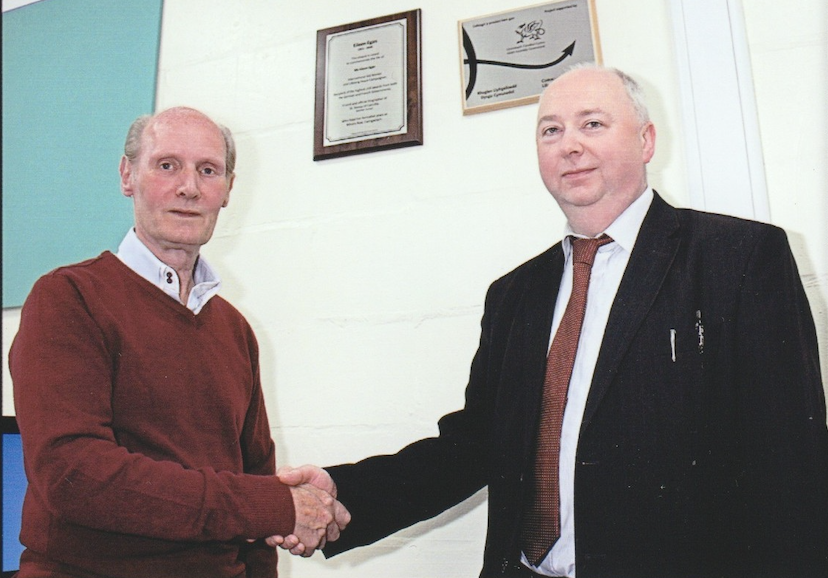
As a result of a lengthy letter to Mr Ali Thomas, the then Leader of Neath and Port Talbot, County Council; followed by a “Talk” on Eileen Egan at Glynneath library, in the presence of Mr Wayne John, Head of the Glamorgan Library Services, I successfully convinced them to raise a plaque, in the library, commemorating Eileen Egan’s life and work and her association with Cwmgwrach. This for me, was the culmination of my determination that this incredible woman, raised in our community, will be remembered here for posterity.
Resources and References:
Cwmgwrach “Valley of the Witch”, by Ian J Currie, pages 340 – 355.
The Egan Chronicles – A Truly Christian Experience by Ian J. Currie.
Photographs donated to the above article by Ian J Currie.