
Anatomy of a Storm:
The weather phenomenon named “The Beast from the East” took place from 22 February to 4 March 2018 and was followed by a “mini Beast from the East” in Mid March.
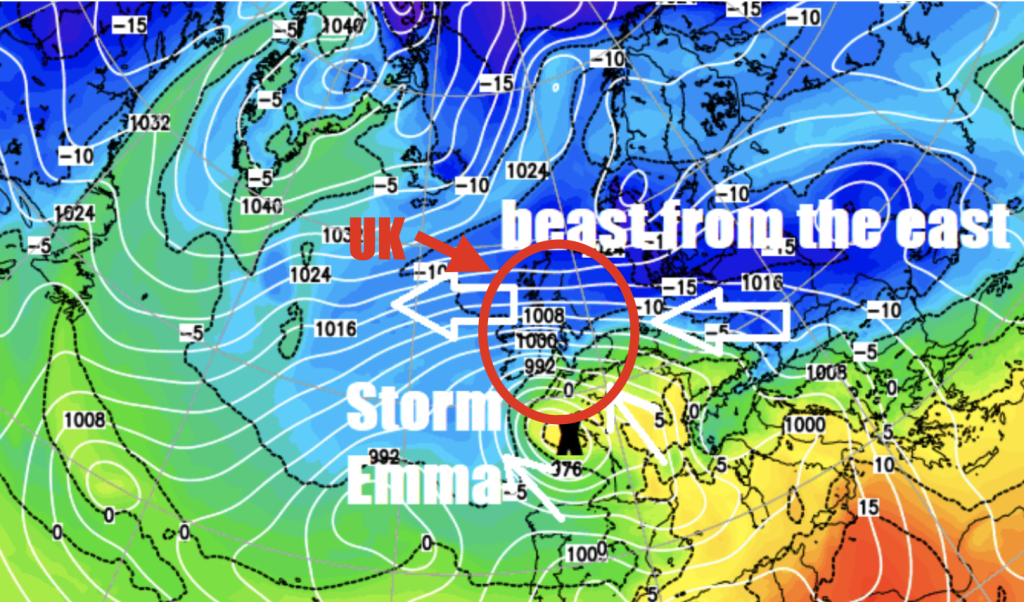
The event was caused by a Siberian polar continental air mass colliding with a moisture-rich storm named Storm Emma coming from theAtlantic. The effect of this collision was to bring sweeping heavy snow blizzards, snow drifts and freezing temperatures to Scandinavia, the wider European continent and the UK. But what I remember more than anything was the freezing driving wind which seemed to come straight of the Russian steppes.
Below is a timeline of the event:
- 22–25 February 2018: Easterly winds from Siberia moved across Great Britain and Ireland, bringing rapidly dropping temperatures and initial snow showers.
- 26 February 2018: The core cold snap arrived with gale-force easterly winds and severe windchill.
- 1 March 2018: The lowest March daily maximum temperature on record was a daytime high of -4.7°C was recorded at Tredegar (Blaenau Gwent) on March 1, 2018.
- 2–3 March 2018: The cold wave collided with Storm Emma, which brought heavy blizzards and deep snow to the south-west of England, South Wales, and Ireland.
- 4 March 2018: The major severe weather event largely subsided.
- Mid March: A mini Beast from the East returned to Wales causing major disruption once again.
Effects of the Storm:
The MET office was to issue a rare Red Weather Warning for parts of South Wales, which indicates a direct danger to life. The Beast from the East was to have devastating impact in Wales with heavy snowfall and massive snow drifts on higher ground (8 feet high in Pontypool) and freezing temperatures plummeting to -5°C and below across Wales which felt even colder due to the severe Easterly wind. The lowest temperature recorded was -12°C in rural high-ground areas of Wales.
This led to severe disruption across Wales with trains being cancelled due to drifting snow, hundreds of schools across the country closing, hospital operation cancelled, frozen or burst water pipes leaving thousands without running water and as usual panic-buying stripping the supermarket shelves of bread and milk across most towns and villages.
Further to the above disruption it was to cost the Welsh economy dearly, with dealing with the emergency leaving a multi pound dent in Welsh Council budgets. As an example Caerphilly and Monmouth councils spent nearly £9000,000 combined on emergency gritting.
The Beast from the East was also to cause the death of 17 people in the UK, mostly road collisions on icy roads, hypothermia and emergency medical incidents. Across the wider Europe continent the cold wave was to cause at least 60+ deaths.
Just as the thaw started to take effect Wales was struck by the mini Beast from the East in mid March. This brought a further blanket of snow and freezing conditions to Wales and further stretched the emergency services to their limits.
Comparison of the Beast from the East with The Big Freeze in 1963 and The Big Snow of 1982:
The Beast from the East stands out for its intense, short termed severity, but in comparison to the historic 1963 Big Freeze it lacks the prolonged catastrophic duration and in comparison to the 1982 blizzards it lacks the overwhelming local snow accumulation.
The winter of 1962 – 63 remains the coldest winter in Wales since 1740. The main factors of this weather event was the single dump of snow and the 2 month duration of the completely frozen ground. The sea froze over in Penarth, fuel ran out because the coal piles froze over, water pipes froze and the River Neath froze over for weeks on end. See article on the Big Freeze of 1963 here: https://gwrachtimeline.co.uk/the-big-freeze-1963
With regard to the comparison with 1982, the January 1982 Big Snow wins out from 2018 for the largest unadulterated snowfall volume which saw a blizzard taking place for 36 – 48 hours which completely buried South and West Wales and created massive 6 metre snow drift which completely covered cars. The military had to be called in with helicopters to drop off food to cut-off villages. See article on the Big Snow of 1982 here: https://gwrachtimeline.co.uk/the-big-snow-of-1982
So in order of severity I would say the Big Freeze of 1963 was by far the worst winter event, with the Big Snow of 1982 in second place due to the amount of snow that fell, and in third place I would put the Beast from the East in 2018 due to it’s short timespan and amount of snow, although the bitterly cold wind coming from the East is worth mentioning along with the coldest March day on record at -4.7°C in Tredegar.
Local Facebook comments:
On the local village Facebook page on the 5th March 2018 Sandi Michell was to post the following:
“Now that the snow has gone and the rain is here. All things back to normal. I’d like to says huge THANK YOU to all the staff in the Premier who kept the store open and even acquired fresh home made bread rolls. Also to all the people I saw out and about checking on our older neighbours and clearing paths. The snow may have caused some upsets but I know being in this village is the best place to be . Well done all.” xxx
The following are comment made to Sandi’s post:
Margaret James
It’s good to know Cwmgwrach hasn’t lost community spirit, especially in time of need.
Janice James-Jenkins
I have to mention Phil Bradley and give a massive thanks to him for always looking out for my mum and his other neighbours, clearing the snow and always checking they’re ok . A true legend. Thanks Phil x
Emma Rowlands
I am just glad I never ran out of milk….. as only substitute I had was Baileys or wine….
Joy 0’Brien
Not a bad substitute.
References and Resources:
Various newspaper articles.
Wiklepedia ~ https://en.wikipedia.org/wiki/2018_British_Isles_cold_wave
A1
Unfortunately I have not found any photos of this event, if I do find some I will attach them to this page.